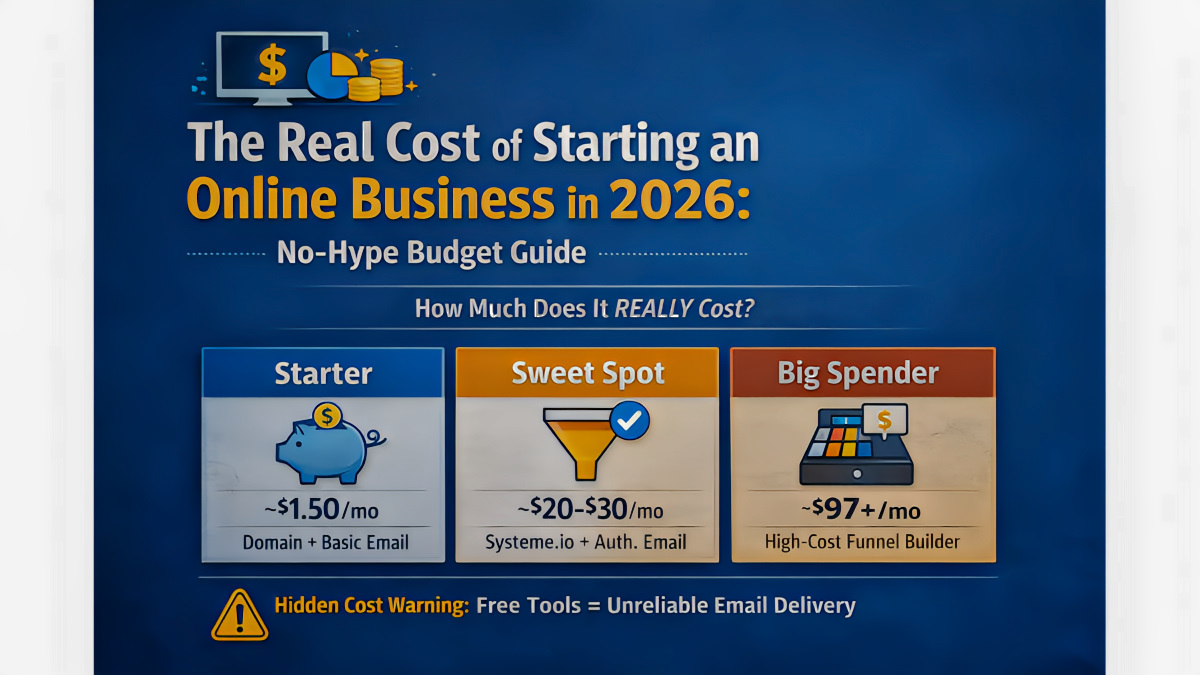
Starting an online business in 2026 costs approximately $39.07 for your first year. That covers a custom domain and professional business email with full DMARC, SPF, and DKIM authentication. Everything else, including your funnel builder, email automation, payment processing, and course hosting, can run on free tiers until your business model is validated. The $39.07 is not optional. It is the infrastructure that determines whether your emails reach inboxes or land in spam.
Section 1: What Is the Real Cost to Start an Online Business in 2026?
The answer is $39.07 for your first year.
Not $0. Not $10,000. Thirty nine dollars and seven cents, if you build it the right way from the start using what I call The Lean Launch Stack.
That number covers two things: a custom domain name and a professional business email address with authenticated sending. Everything else you need to launch a digital product or affiliate business runs on free tiers in year one.
Most articles answer this question one of two ways. Either they tell you that you can start for free, which is technically true and practically misleading, or they give you a range from $100 to $60,000 depending on your business model, which is accurate for ecommerce and Amazon FBA but completely irrelevant for someone building a digital business part time.
Neither answer helps you.
I work full time in construction. I build digital systems in the evenings and weekends. I have been through the confusion of not knowing what to spend, what to skip, and what actually matters in the first year. This article is the answer I wished existed when I started.
| Business Model | Typical First Year Cost | Why |
| Affiliate Marketing | $39.07 | Domain and email only. Platform is free. |
| Digital Products | $39.07 | Domain and email only. Systeme.io free plan covers everything else. |
| Blogging | $39.07 to $150 | Add hosting if you want WordPress. Not required to start. |
| Ecommerce | $500 to $3,000 | Inventory, Shopify or WooCommerce, payment processing, advertising. |
| Amazon FBA | $2,000 to $10,000 | Product sourcing, fulfilment fees, Amazon advertising, and LLC registration. |
| Dropshipping | $100 to $500 | Platform fees, paid ads, and product testing costs. |
This article covers affiliate marketing and digital products because that is the model that requires the least capital to validate and the most misunderstood startup cost structure.
Section 2: Do You Have This Problem? Diagnose Where You Are
This section is for two types of reader.
The first is someone who has not started yet and wants to know exactly what to spend before building anything. If that is you, skip to Section 4.
The second is someone who has already started and something is not working. Use the checklist below.
Your emails are landing in the spam folder. You are likely sending from a free Gmail or Yahoo address without domain authentication. This is not a content problem. It is an infrastructure problem that costs $39.07 to fix permanently.
You are paying for multiple tools that do not connect. You have fallen into what I call the Feature Trap. You are buying software to solve confusion instead of building a connected system. Go to Section 4.
You are spending more than $50 per month without a single sale. Your costs are ahead of your validation. This is the most expensive mistake in online business and it is almost always caused by buying tools before the core system is proven. Go to Section 4.
Your domain is connected but emails still go to spam. Your sending domain authentication records may be missing or misconfigured. SPF, DKIM, and DMARC records all need to be correctly in place. Go to Section 5.
You feel like you need more tools to make things work. You probably need fewer tools configured correctly, not more tools added on top.
Section 3: What Causes Beginners to Overspend or Underspend
Most beginners do not get startup costs wrong because they are reckless. They get it wrong because no one gives them a straight answer about what is actually required versus what is being sold to them.
Here are the most common causes.
- Believing free means being functional. A free Gmail address works for personal email. In 2026 it will not work reliably for business email. Google, Yahoo, and Microsoft enforce authentication requirements for bulk senders. Without SPF, DKIM, and DMARC records on a custom domain, your emails go to spam regardless of how good your content is. The average email open rate for authenticated senders is around 20 to 30 percent. For unauthenticated senders that number drops dramatically and in many cases to near zero.
- Confusing a domain with hosting. You do not need hosting to start. Systeme.io allows you to connect a custom domain via DNS settings without a separate hosting plan. Your landing pages and funnels run on your domain through Systeme.io at no cost. I assumed I would need hosting immediately when I first set this up. I did not. That is one expense removed entirely in year one.
- Buying tools to solve confusion. I have seen the same pattern repeat consistently among people starting out. They buy a funnel builder, then a standalone email platform like ConvertKit or Mailchimp, then a link tracker, then a course hosting platform. Three months in they are paying $150 to $200 per month. They still have not made a sale. Every tool purchase was trying to solve a problem that a simpler system would have prevented.
- Not accounting for renewal pricing. Most hosting and email platforms use low promotional pricing to attract new customers. The standard renewal rate is almost always higher. Always budget using the standard monthly rate, not the headline promotional price. For Hostinger Business Email that means budgeting $2.99 per month, not a lower promotional figure that only applies on a long term prepaid commitment.
- Skipping email authentication entirely. This is the single most expensive mistake a beginner makes. A list of 500 subscribers that you cannot reach because your emails land in spam is not a free problem. It costs you every subscriber you cannot convert and every sale that never happens because your follow up sequence never arrived. The email authentication cost of $19.08 per year is not optional. It is the thing that makes the list worth building.
- Over-investing before validating. Paying for a premium funnel builder, a dedicated email platform, a link tracker, and a course hosting tool before making a single sale commonly costs between $150 and $250 per month. That is $1,800 to $3,000 in year one before any revenue is generated. Systeme.io’s free plan replaces every one of those tools at no cost while the business model is being validated.
Section 4: The Lean Launch Stack The Right Way and the Wrong Way
There is no version of starting an online business in 2026 that costs $0 and works properly. The question is not whether you spend money. The question is whether you spend the right money at the right time on the right things.
Here are the two paths.
The Right Way: The Lean Launch Stack
The Lean Launch Stack is the minimum viable infrastructure for a digital or affiliate business in 2026. It covers everything required for authenticated email delivery, professional branding, funnel building, email automation, and payment processing. It costs $39.07 in year one.
How much does it cost to start an online business the right way? For a digital product or affiliate business, the Lean Launch Stack costs $39.07 in year one. That is one custom domain at $19.99 and one professional email address at $19.08 through Hostinger Business Email. Systeme.io’s free plan handles everything else including funnels, email sequences, automation, and payments at no cost.
| Item | Provider | Annual Cost | What It Does |
| Custom Domain (.com) | Hostinger | $19.99 | Professional identity. Required for email authentication. Without this your emails go to spam. |
| Business Email | Hostinger Business Email | $19.08 ($2.99 per month) | Custom domain email address. Required for SPF, DKIM, and DMARC authentication. Cannot use Gmail or Yahoo for authenticated sending. |
| Funnel Builder | Systeme.io Free Plan | $0 | Build landing pages and sales funnels on your connected domain. |
| Email Automation | Systeme.io Free Plan | $0 | Email sequences and automation included. Unlimited sending on all plans. |
| Payment Processing | Systeme.io Free Plan | $0 | Stripe and PayPal integration with 0% transaction fees. |
| Course Hosting | Systeme.io Free Plan | $0 | Host one course with unlimited students. |
| SSL Certificate | Included with Hostinger and Systeme.io | $0 | Secure HTTPS connection. Required for trust and deliverability. |
| Total Year One | $39.07 | Everything needed. Nothing that is not. |
Domain name options and costs: .com: $19.99 per year via Hostinger .net or .org: $17.99 per year via Hostinger
What The Lean Launch Stack gives you from day one:
A professional funnel and landing pages running on your own domain. An email list with fully authenticated sending so emails reach inboxes rather than spam folders. Payment processing with 0% transaction fees through Stripe or PayPal. Course or digital product hosting included at no cost. The infrastructure to run affiliate offers through a connected funnel.
What The Lean Launch Stack does not include yet and does not need to:
A WordPress website. Not required to start. Systeme.io pages run on your connected domain without it. A paid email platform. Systeme.io’s built-in email sending handles sequences and broadcasts at no cost. A premium funnel builder. Three funnels on the free plan is sufficient to validate a first offer. Hosting. Not needed until you decide to build a full WordPress website.
When to upgrade from the free plan: The Systeme.io free plan includes one automation rule. That is the first real limit most builders hit, typically before reaching 50 contacts rather than the 2,000 contact ceiling. When you hit that wall and your system is generating revenue, move to the Startup Plan at $170 per year. At that point the cost is justified because the system has already proven it works. Moving before that point is a Feature Trap decision.
If you plan to add a WordPress website at any point, Hostinger WordPress hosting starts from $2.99 per month on promotional pricing. Factor in the standard renewal rate when budgeting. Your domain is already registered so there is no additional domain cost.
The Wrong Way: The Feature Trap
The Feature Trap is what happens when confusion is solved with tools instead of clarity.
I have watched the same sequence repeat consistently. Someone starts an online business. Something does not work immediately. Instead of diagnosing the system, they buy another tool that promises to fix the problem. Then another. Then another. Three months later they are paying $185 per month or more and they have still not made a single sale.
The tools are not necessarily bad. Some of them are genuinely good. The problem is the sequence and the timing. Buying solutions to problems you have not yet encountered is how beginner budgets get destroyed before the business is validated.
| Tool | Monthly Cost | The Problem |
| Premium funnel builder | $97 | Duplicates what Systeme.io does on its free plan. |
| Standalone email platform (ConvertKit or Mailchimp) | $29 | Duplicates Systeme.io’s built in email automation. |
| Link tracker | $20 | Not needed before you have traffic to track. |
| Separate course hosting platform | $39 | Systeme.io includes this at no cost on all plans. |
| Total | $185 per month minimum | $2,220 per year before making a single sale. |
The Feature Trap does not fail loudly. It fails slowly. The monthly cost feels manageable. The tools feel productive. Six months in the spend is very real and the revenue is not. The instinct at that point is to add another tool to fix it.
| Comparison Point | The Lean Launch Stack | The Feature Trap |
| Year one cost | $39.07 | $2,220 minimum |
| Number of platforms to manage | 2 (Hostinger and Systeme.io) | 5 or more |
| Email authentication included | Yes | Depends on configuration |
| Payment processing fees | 0% via Systeme.io | Varies by platform |
| Course hosting included | Yes | Separate paid platform |
| Validation before spending | Yes | No |
| Risk if business model fails | $39.07 lost | $2,220 or more lost |
The fix is not finding cheaper tools. The fix is building the simplest connected system, validating it with real people, and only then adding tools that solve real problems you have actually encountered.
Section 5: The 2026 Deliverability Reality Why the $39.07 Is Non-Negotiable
How much of your email actually reaches your audience without authentication? Studies from major email deliverability analysts consistently show that unauthenticated emails from custom domains have inbox placement rates below 20 percent on Gmail and Yahoo. Some estimates put legitimate unauthenticated senders at open rates of 5 percent or lower due to spam folder placement. For authenticated senders following best practices the average inbox placement rate is above 95 percent.
The $39.07 in The Lean Launch Stack is almost entirely an authentication cost. Here is what it buys technically.
What Is SPF and Why Does It Matter?
SPF stands for Sender Policy Framework. It is a DNS record that tells receiving mail servers which servers are authorized to send email on behalf of your domain. Without an SPF record, receiving servers have no way to verify that an email claiming to come from your domain is legitimate. Gmail, Outlook, and Yahoo all check for SPF before accepting email.
What Is DKIM and Why Does It Matter?
DKIM stands for DomainKeys Identified Mail. It is a digital signature attached to every email you send. The receiving mail server checks this signature against a public key stored in your DNS records. If the signature is valid, the email is verified as untampered. DKIM is one of the three core authentication requirements enforced by major email providers in 2026.
What Is DMARC and Why Does It Matter?
DMARC stands for Domain-based Message Authentication, Reporting, and Conformance. It is a DNS policy record that tells receiving servers what to do when an email fails SPF or DKIM checks. Options include quarantining the email, which means send it to spam, or reject it outright. Without a DMARC record your domain has no policy in place and receiving servers make their own decisions, which usually means spam folder placement for unverified senders.
What Is DNS and How Does It Connect Everything?
DNS stands for Domain Name System. It is the system that translates your domain name into the technical records that control where your website, email, and other services point. SPF, DKIM, and DMARC are all configured as DNS records inside your domain registrar. For Hostinger users this is done inside the hPanel DNS zone editor. For other registrars the process is similar but the interface differs.
Note on live webpage and deliverability: While SPF, DKIM, and DMARC are the documented and publicly enforced authentication standards, many deliverability professionals recommend ensuring your sending domain resolves to a functioning webpage as a general best practice for sender reputation. A domain pointing to a blank page or a 404 error may be interpreted as lower credibility by some spam filters. The officially documented requirements from Google, Yahoo, and Microsoft are SPF, DKIM, DMARC, one-click unsubscribe for bulk senders, and a spam complaint rate below 0.3 percent. Pointing your domain to a live page is strongly advisable but treated here as best practice rather than a confirmed hard requirement.
In 2026 Google, Yahoo, and Microsoft enforce a spam complaint rate threshold of 0.3 percent for sending domains. Exceeding this threshold damages deliverability regardless of authentication records. Always test new emails on a personal inbox before sending to your list. Only send to people who have actively opted in and maintain a clean list.
The math on skipping authentication: a list of 500 subscribers where emails land in spam has an effective reach close to zero. The $19.08 annual cost of Hostinger Business Email is not an expense. It is the thing that makes the list worth building.
Section 6: Frequently Asked Questions
Can I start an online business with no money?
You can open accounts for free on platforms like Systeme.io without spending anything. However a functional business that reaches customers through email requires a custom domain and authenticated email sending. That costs approximately $39.07 in the first year. You cannot build an email list that works without it. Starting with $0 is technically possible. Starting with $0 and expecting emails to reach your audience is not realistic in 2026.
What is the cheapest online business to start?
Affiliate marketing and digital product businesses have the lowest startup costs of any online business model. Using The Lean Launch Stack, the first year cost is $39.07 covering a custom domain and authenticated business email. Everything else including funnels, email sequences, payment processing, and course hosting runs on Systeme.io’s free plan with no credit card required.
Do I need a website to start an online business?
No. You need a domain name, but not necessarily a hosted website. Tools like Systeme.io allow you to connect a custom domain via DNS and run landing pages and funnels on that domain without a separate hosting plan. When I set up my first funnel I skipped hosting entirely. The domain connected directly to Systeme.io and the pages ran on my domain from day one. Hosting becomes relevant when you want to build a full WordPress website, which is a separate decision from launching your first funnel.
Do I need a business email address?
Yes. In 2026 sending business email from a free Gmail or Yahoo address is not viable for building an email list. Major providers including Gmail, Outlook, and Yahoo enforce authentication requirements that can only be satisfied through a custom domain email with SPF, DKIM, and DMARC records in place. Hostinger Business Email costs $2.99 per month or $19.08 per year and gives you a professional address at your domain with full authentication support.
Can I use Gmail for my business email?
You can use Gmail personally but not as your business sending address for email marketing. Free Gmail addresses do not support the DNS-level authentication records that Google, Yahoo, and Microsoft require for bulk senders. If you want to use the Gmail interface with a custom domain, Google Workspace starts at $7 per user per month. For most beginners building a lean stack, Hostinger Business Email at $2.99 per month is more cost effective and covers all authentication requirements.
Can I use Outlook or Cloudflare Email instead of Hostinger?
Yes. The requirement is not a specific provider. The requirement is a custom domain email address with SPF, DKIM, and DMARC records properly configured. Microsoft 365 Business Basic provides Outlook with a custom domain starting at $7 per user per month. Cloudflare Email Routing is a free option that forwards email to an existing inbox but does not provide a full sending mailbox on its own. For a complete sending and receiving setup at the lowest cost, Hostinger Business Email at $2.99 per month is the option documented throughout this site.
Is Shopify required to start an online business?
No. Shopify is an ecommerce platform designed for physical product stores. If you are building a digital product or affiliate business, Shopify adds cost and complexity you do not need. Systeme.io handles payment processing for digital products with 0% transaction fees on all plans including the free tier. Shopify’s basic plan costs $39 per month plus transaction fees, which is unnecessary overhead for a lean digital business.
Do I need an LLC or legal registration before starting?
In most cases no. You can start as a sole proprietor to validate your business model. Focus the first year budget on technical infrastructure: domain, email authentication, and your platform. Legal structures add cost and complexity before there is revenue to protect. Consult an accountant or legal advisor in your jurisdiction before making this decision as requirements vary by country and region.
Is it better to pay monthly or annually for tools?
Start monthly on anything you are not certain you will keep. Once your system is generating enough revenue to cover the cost, switch to annual billing. Systeme.io’s Startup Plan costs $17 per month on monthly billing or $170 per year on annual billing, saving $34 annually. Only commit to annual billing once the platform is proven to work for your specific setup.
Can I start an online business from my phone?
You can manage much of the early setup from a phone. Systeme.io has a mobile-accessible interface and Hostinger’s hPanel works on mobile browsers. However configuring DNS records for email authentication and building funnel pages is significantly easier on a desktop or laptop. The initial setup of The Lean Launch Stack is best done on a computer. Day to day management, content creation, and email management can be handled from a phone once the system is running.
What happens if I buy a domain but not hosting?
You can still use the domain productively. Connect it to Systeme.io via DNS and your funnel pages will show your domain URL instead of a Systeme.io subdomain. This is exactly how The Lean Launch Stack operates in year one. Your business email also uses the domain without requiring hosting. Hosting becomes relevant when you want to build a full WordPress website, which can be added to Hostinger later without changing your domain.
Do I need WordPress to start an online business?
No. WordPress is one option for building a website but it is not required for a digital or affiliate business. Systeme.io builds and hosts your landing pages and funnels without WordPress. If you want to run a blog for SEO alongside your funnel, WordPress on Hostinger is a strong combination. But it is an optional addition to The Lean Launch Stack, not a requirement for launching.
Section 7: Key Takeaways
The real cost to start an online business in 2026 for a digital or affiliate business is $39.07 in year one.
That covers one custom domain and one professional business email address with full SPF, DKIM, and DMARC authentication.
Systeme.io’s free plan covers funnels, email automation, payment processing, and course hosting at no cost.
The Feature Trap costs $185 per month or more and is almost always entered before the business model is validated.
Email authentication is not optional in 2026. Google, Yahoo, and Microsoft all enforce authentication requirements. Unauthenticated senders face inbox placement rates that make building a functional email list effectively impossible.
The Lean Launch Stack is two platforms: Hostinger for domain and email, Systeme.io for everything else.
The first upgrade trigger is the Systeme.io automation rule limit, not the contact limit. Most builders hit this before reaching 50 contacts.
Section 8: Related Guides
These guides walk through the exact setup of The Lean Launch Stack step by step.
Systeme.io Account Settings: What to Configure Before You Build Anything
What it covers: Every settings section in Systeme.io in the correct order. What to configure immediately, what can wait, and what breaks if you skip it. Includes email settings, payment settings, timezone, currency, and domain connection.
Systeme.io Emails Not Sending or Going to Spam? Fix It With Hostinger DNS
What it covers: The complete email authentication process including SPF, DKIM, CNAME records, and DMARC TXT record configuration, plus sender address confirmation and deliverability troubleshooting.
Section 9: Build The Lean Launch Stack Today
The cost of starting an online business in 2026 is under $40.
Thirty nine dollars and seven cents for the infrastructure that makes everything else work, and $0 for the platform that runs your funnel, your email list, and your payment system in year one.
The difference between The Lean Launch Stack and the Feature Trap is not the quality of the tools. It is the sequence. Build the foundation first. Validate the system with real people. Add tools only when you have real problems they solve.
The guides in Section 8 walk through every step in the correct order. Work through them in sequence and the system will be connected and functioning before you spend a dollar on anything optional.
I work full time in construction and document this build in real time. No income claims, no inflated screenshots, no shortcuts. If you want to follow the real process, subscribe on YouTube and build it alongside me.
Get your free Systeme.io account, no credit card required: Get your domain and business email with Hostinger.
Leave a Reply